Touring the documentary across Canada
I’ve been talking about taking The Hands that Feed Us on tour since before I started filming. So, the existence of the tour isn’t news. What’s newsworthy are the actual details: On March 3rd, I’ll begin my tour on Vancouver Island and then travel east over the course of six months, spending roughly a month in each province. I’ll arrive in the Maritimes sometime in August, take the ferry over to Newfoundland, then turn around and head west until I’m back in B.C. for February 2027. I’ll be on the road for a year, and my goal is to show the film 250 times (five days a week!) and to host a discussion after every screening.
Some of those discussions will become part of a podcast that will bring everyone who sees the film into a wider community, but what makes them worthwhile is that each will be specific to a particular place in Canada. The issues of financial viability and access to land are universal, but they are solved farm by farm, community by community, and they all have to decide for themselves what action they want to take. My film can’t possibly be a solution for all those different needs. What it can be is a catalyst to bring those communities together. Showing the film is a way to get a group of people together in a single room and create a conversation about their specific challenges.
My hope is that some of those conversations will turn into permanent solutions and bigger projects, but that part is up to the individuals. My tour can’t solve the farm income crisis. But it can make these discussions part of a larger whole. I can host discussions, person by person, community by community, and turn them into a podcast that will be heard well beyond the individuals who see the film on any given night.
There are three types of discussions that I’m planning: an evening Town Hall Discussion, a Weekend Workshop, and a Family-and-Friends event. Town Hall Discussions and Weekend Workshops will be done in partnership with organizations (e.g. agricultural groups, county governments, chambers of commerce, service clubs, and church groups). But I’m most excited about doing Family-and-Friends events and bringing the film to people’s living rooms, basements, and barns.
Town Hall Discussions are intended to be semi-public meetings where community issues can be discussed with an organization that already has some capacity to take action. They will showcase a farm or business affiliated with that organization, and we will dig into one particular challenge that that farm is facing as a case study. Then we’ll watch the film, and talk about how the film has changed our perception of that challenge. The goal is to come out of the discussion with one specific, concrete action that the organization can take to help its members deal with similar challenges.
Weekend Workshops are more in-depth. They start with a Town Hall Discussion, then add a second day that starts implementing the action that was identified on the first day. The goal is for the workshop to plant the seed of a permanent group that is working on a particular issue in that community, and for all the groups that I work with to be united into a bigger campaign that addresses the challenges of running a small-scale, rural business (i.e. most farms).
Family-and-Friends events are quick and easy. They are basically just a movie night for friends and neighbours — with the bonus that the filmmaker (me) will be there to talk about the movie afterwards. They are informal, and are best with a small amount of people: 10-15 is plenty! Any more is too big to maintain a single conversation in the group, and my goal is to facilitate whatever conversation comes out of the film. It’s a way to talk about neighbourhood issues in a friendly way. Everyone likes a movie night! All you need is to invite your friends and provide a place to gather. I’ll bring the movie and everything else.
My mission for the tour is to rebuild Canada’s economy in a way that makes small-scale farming — and small-scale business in general — a viable occupation. I intend to visit as many farms and agricultural communities as I can, find the farmers and businesses that are making a go of it, and use them as case studies that show how our economy is actually built.
I’m planning the tour in two month blocks, so right now I’m scheduling stops in B.C. and Alberta in March and April. If you want me to bring The Hands that Feed Us to your community, check when I’ll be in your province / territory, and then sign up here to host.
Here is the schedule of what months I’ll be in which provinces:
- March 2026: B.C.
- April 2026: Alberta
- May 2026: Saskatchewan & Manitoba
- June 2026: Ontario
- July 2026: Québec
- August-September 2026: Maritimes & Newfoundland
- October 2026: Québec
- November 2026: Ontario
- December 2026: Manitoba
- January 2027: Saskatchewan & Alberta
- February 2027: B.C.
How to invest romantically
One of the central lessons of The Hands that Feed Us is that the economic challenges that farmers face don’t really have anything to do with farming at all. At root, I believe the challenges are caused by a confusion about how investment works, and that confusion is institutionalized in how we think about finance. Most of the money that is “invested” in Canada is invested institutionally through financial firms that their money managers. If you walk into a bank and hire an “investment advisor”, the implicit deal is that you are asking them to take your money and turn it into more money: To grow your investment. Call this approach “financial investment”. But when governments talk about investment, they use the word in a very different way. They talk about investing in things: Roads, public transit, hospitals, schools, pipelines, etc. When governments “invest”, they spend money to build things that provide some kind of benefit to society. The point of investing in a road is to reap the benefits of having a road, not harvest a profit from building the road. There isn’t as obvious an adjective for how governments invest, but in the film, I call this kind of investment “romantic”.
These two senses of investment are nearly opposites: Investing “financially”, the way banks and money managers do it, means spending wealth to get money. Investing “romantically”, the way governments do it, means using money create wealth. You can probably tell which of the two senses of investment I consider to be the “real” meaning of investment, but both meanings are in common use without much awareness that there is a difference. There’s also a widespread assumption that wealth is the same thing as money or that wealth can be measuered in money, but that’s a discussion for a different day.
For today, if you’re interested in going deeper into the idea of investing romantically, I wrote a blog post: How to invest romantically.
Now streaming on Super Channel Plus
The Hands that Feed Us had its cable TV debut on Super Channel on November 8th. Super Channel has licensed the film for two years, so it’s likely to have more TV screenings, but the schedule is up to Super Channel. Upcoming screenings are listed on the Super Channel site, and the film screens most often on Super Channel FUSE, which is their documentary channel.
The film is also available through their streaming service: Super Channel Plus. You can also subscribe through Amazon Prime and Apple TV.
Up next: Preparing for a year-long road trip
When I travelled across Canada in 2020, I packed everything into my car, and I stayed on five farms over the course of eight months. It was COVID, and I was very grateful for the farms that took me in while I was travelling, and I made a point of joining the farm ‘bubble’, and I minimised my contact with the outside world.
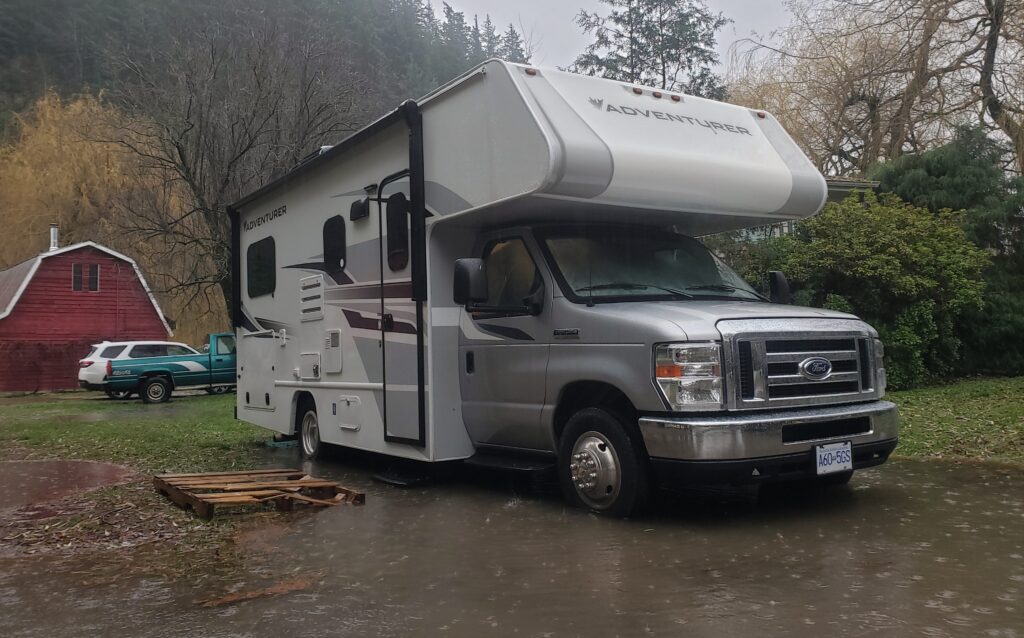
This time, I’ll be travelling somewhere new every day, and it’s almost a full time job figuring out my itinerary and where I’m going to stay. To make all this possible, I’ve moved into a motorhome that my Aunt Donna has nicknamed “T-Rex”. As you can see in the photo, I found myself a nice lakefront parking spot during the recent flooding in Abbotsford. Luckily, I was able to move to higher ground when the water started to rise above the wheel rims.
Making T-Rex road-ready is a major task, as I expect to be facing the Canadian winter. I’m upgrading the solar and electrical systems, replacing all the seals and weather stripping, getting an RV “skirt” for insulation, installing thermal monitoring and better air circulation, and wrapping the pipes in heat tape. The goal is to make it livable in all situations.
In addition, I’m laying the groundwork for the tour: I’m booking tour stops, rebuilding the website, updating social media, and starting a podcast, all at once. I’ve also started posting daily YouTube updates about what the tour will be. These are a bit dry at the moment; explaining what the tour is about isn’t as exciting as the tour itself, but once the tour starts, I’ll be posting a new video every day … from a different part of Canada every day, and I’ll share what I’ve seen on the road.
If I’m going to host 250 discussions, I need a whole lot of prep time, since once I’m on the road I’ll be driving and watching my movie almost every day. It’s a big job, and it’s all building up to my departure on March 3rd…
Watch the film
- Cable TV on Super Channel FUSE
- Stream the film on Super Channel Plus, or get Super Channel through Amazon Prime or Apple TV.
- January 19th, 5PM PST: Vancouver, B.C., Montalbano Family Theatre at Library Square Convention Centre (RSVP)
Follow the tour
The best place to follow the tour will always be the website. It will be the first to get podcast episodes, YouTube Updates, Vlogs, Blogs, Newsletters, photos, etc., and it will continue to hold an archival record of my past adventures.
Second to that, YouTube is the primary place to find updates about the project. It’s also the only place I’ll be interacting publicly and watching comments, so if you want to get my attention, find me there.
I’m also experimenting with Discord as a way to help people who have hosted Town Hall Discussions or Weekend Workshops keep working on the plans that have been made during those events. Most of these discussions will be private for the particpants of those events, but, at least for the moment, we are hosting a channel for public chat as well. I will not be posting public updates to Discord, but if you are looking for discussion with other people around The Hands that Feed Us, that will be the place.
We’re on a lot of other social media as well … just don’t expect them to be quite as up-to-date, or quite as responsive as the options above.
- Website: https://thehandsthatfeedus.ca/
- YouTube: https://www.youtube.com/@thehandsthatfeedus1565
- LinkedIn: https://www.linkedin.com/company/the-hands-that-feed-us
- Facebook: https://www.facebook.com/thehandsthatfeedus/
- Instagram: https://www.instagram.com/the_hands_that_feed_us/
- TikTok: https://www.tiktok.com/@thtfu7
- Threads: https://www.threads.com/@the_hands_that_feed_us
- Discord: https://discord.gg/9tXaatkZF8
Host a screening event
There are three main types of events that I’ll be offering on tour:
- Family & Friends
- For individuals
- 10-15 people
- Host in your basement, your barn, or your living room
- Screening of The Hands that Feed Us & an informal post-screening discussion
- Free (or by donation)
- Scheduled time-permitting and if and when I’m in the area for a bigger event (within a three hour drive)
- Town Hall Discussion
- For small, member-based organizations
- 20-50 people
- Four hours, including a screening of The Hands that Feed Us & two hours of facilitated discussion, one before, one after the film
- Host in your own space or rent a community hall
- $1,200 commercial / $500 non-profit
- Weekend Workshop
- For larger member-based organizations & government departments
- 50-150 people
- Either one long day or two short days, including a screening of The Hands that Feed Us & six hours of facilitated discussion and workshopping
- Includes ongoing post-workshop support for the plan of action & access to participants from other workshops
- Host in your own space or rent a community hall
- $2,500 commercial / $1,000 non-profit
Individuals should sign up for a Family & Friends screening, or if you want something bigger, suggest a partner organization that can help bring in more people and handle logistics.
Ideal partners include:
- Agricultural groups (e.g. 4H, National Farmers Union)
- Rural / County / Municipal governments
- chapters of Service Organizations (e.g. Rotary Club, Lions Club, church groups)
- Chambers of Commerce